Table of Contents
For someone new to cricket, the powerplay can seem confusing. Why are fewer fielders allowed near the boundary? Why do batters often attack more aggressively during the opening overs? Understanding the powerplay makes it much easier to follow modern limited-overs cricket, particularly T20 matches.
The powerplay is essentially a period when specific fielding restrictions apply. These restrictions are designed to create more opportunities for attacking cricket and prevent the fielding team from placing too many players on the boundary.
1. What Is a Powerplay?
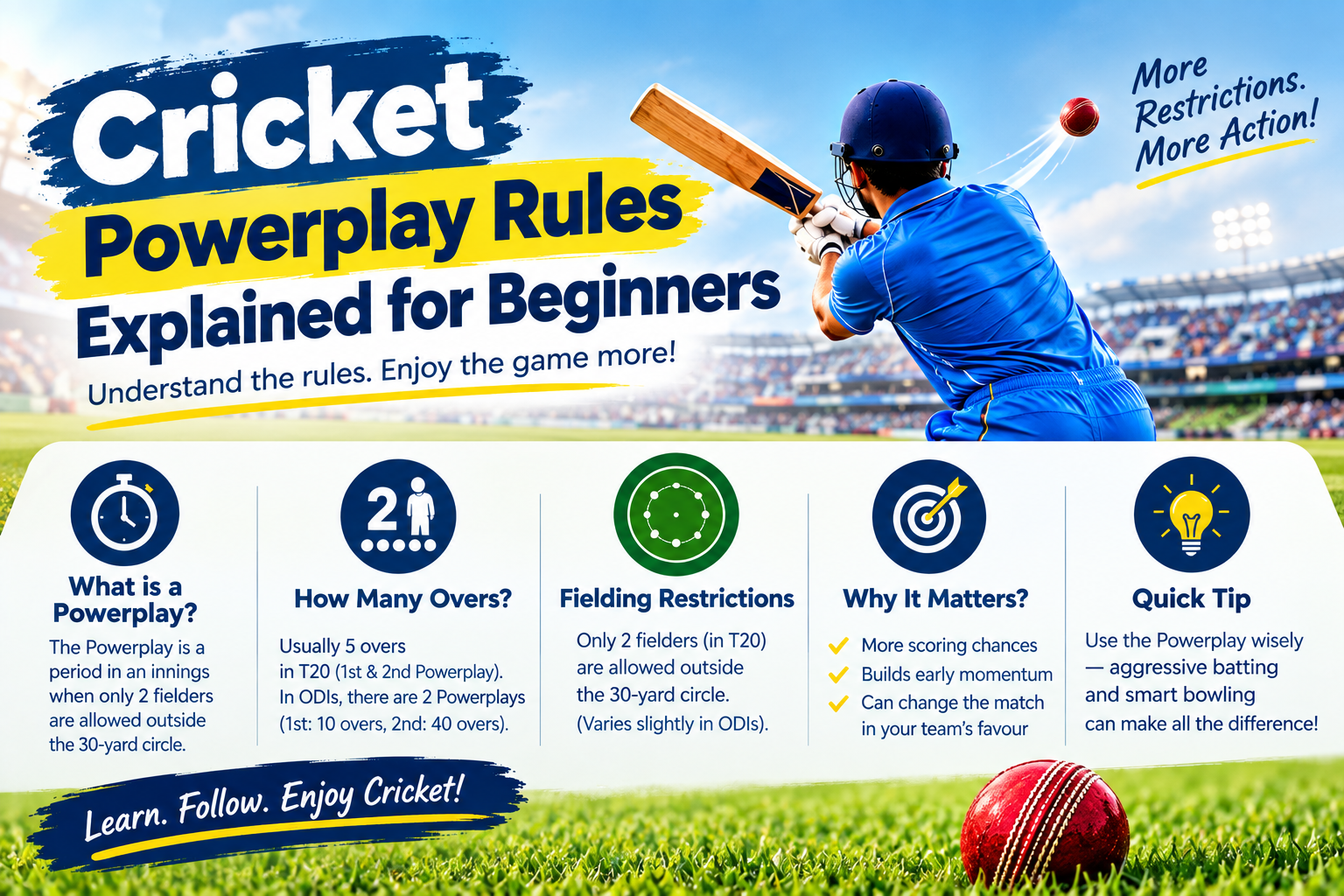
In limited-overs cricket, a powerplay refers to a specific period of an innings during which restrictions are placed on fielding positions.
In T20 cricket, the first six overs are generally known as the powerplay. During this period, only a limited number of fielders can be positioned outside the designated inner fielding circle.
This creates gaps in the outfield and gives batters more opportunities to score boundaries.
2. Why Does the Powerplay Matter?
The powerplay can have a major influence on the final result of a match. Since the fielding team has fewer options for protecting the boundary, batters often look to score quickly.
Opening batters may use attacking strokes through gaps, play over the infield, or target particular bowlers. At the same time, they must avoid unnecessary risks because losing early wickets can put pressure on the rest of the batting lineup.
This balance between aggression and control is one reason powerplay overs are so exciting for cricket fans.
3. How Batters Approach the Powerplay
Different players use different strategies during the opening overs. Some batters immediately look for boundaries, while others focus on finding gaps and rotating the strike.
Good powerplay batting is not simply about hitting sixes. Batters need to understand the pitch, assess the bowler's pace and line, and identify which areas of the field are open.
A well-timed boundary can significantly improve the scoring rate, but singles and doubles remain important because they maintain momentum.
4. How Bowlers Respond
Bowlers also have specific strategies for dealing with the powerplay. Fast bowlers may use swing, seam movement, changes of pace, or variations in length to make scoring difficult.
Captains can also use field placements strategically within the permitted restrictions. The objective is often to create pressure and encourage batters to attempt difficult shots.
Taking wickets during the powerplay can be particularly valuable because it can prevent the batting team from establishing early momentum.
5. Powerplay and Cricket News
Because the opening overs can dramatically change the direction of a match, powerplay performances are frequently discussed in cricket news. Analysts often examine run rates, wickets, boundary counts, and individual performances to explain how a team gained or lost momentum.
Fans can also learn a lot by watching how captains adjust their tactics once the powerplay ends.
Websites such as www.cricbet99.com may appear in online cricket-related content and discussions. Users should independently verify any platform they consider using and make sure their activities comply with applicable laws and regulations.
6. What Happens After the Powerplay?
Once the powerplay ends, fielding restrictions change. Captains gain greater flexibility when positioning fielders near the boundary.
This often changes the batting strategy as well. Batters may concentrate more on rotating the strike, targeting specific bowlers, and finding gaps rather than relying heavily on powerplay fielding restrictions.
Conclusion
The powerplay is an important tactical phase of limited-overs cricket. For beginners, the key idea is simple: fielding restrictions create more attacking opportunities during the opening overs.
Understanding how batters exploit these gaps, how bowlers try to limit scoring, and how captains adjust their fields makes watching T20 cricket much more enjoyable. Keeping up with cricket news can also help fans understand the tactical decisions that influence matches.